Straight answers to common radiant barrier questions: R-value, winter effects, floor vs rafter installs, perforated foil, shingle heat and cell signals.
Radiant barriers get sold hard in Texas, and the sales pitch doesn't always line up with how the product actually works. That leaves homeowners with a lot of good questions. Below are the ones that come up most often, with straight answers.
If you want the background first, our article on how a radiant barrier works covers the basics of radiant heat and why foil blocks it.
No. Insulation like fiberglass or cellulose slows heat moving through it and is rated by R-value. A radiant barrier is a reflective, low-emittance foil that blocks radiant heat across an air space. A sheet of foil on its own has essentially no R-value, which is why the phrase radiant barrier insulation confuses people. Some products combine foil with bubble wrap or foam, and any R-value they list depends on how they're installed and what air spaces they face.
In a Texas attic you want both: a radiant barrier under the roof and a proper depth of insulation on the floor.
ENERGY STAR recommends R-38 to R-49 for most Texas attics. Depending on the product, that can mean well over a foot of blown fiberglass or cellulose. A radiant barrier doesn't change that target. If your insulation is far short of it, adding insulation often returns more per dollar than the barrier, and plenty of homeowners do both on the same visit. Our insulation guides cover the options.
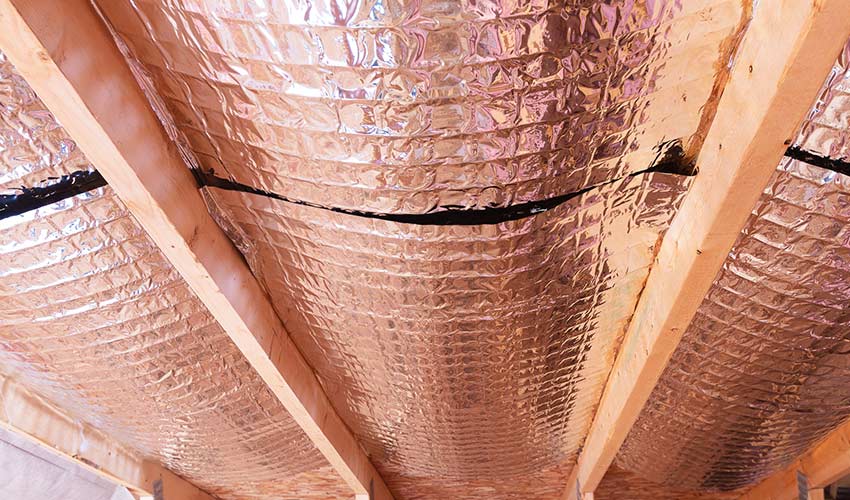
For most Texas homes, on the rafters with the foil facing down. Foil laid over the attic insulation collects dust, and dust ruins its low emissivity over time. Solid foil on the floor can also trap moisture on top of the insulation. Rafter installs stay clean and keep working for decades. Floor installs mostly show up in attics with very little headroom, and even there a perforated product is a must.
Perforated radiant barrier has tiny holes punched through it so water vapor can pass. That keeps moisture from getting trapped against one side of the foil. For rafter installs in existing homes, perforated foil is the usual choice. The holes are small enough that they barely affect how much heat the foil blocks.
Yes. A radiant barrier works with your soffit and ridge vents, not instead of them. Installers keep the soffit vents clear and stop the foil short of the ridge so hot air can still flow up and out. If your attic has spray foam on the underside of the roof deck, it isn't vented at all, and a radiant barrier would add very little.
Plenty of homeowners do. The work is mostly stapling rolls of foil to rafters. The hard part is the setting. A Texas attic in summer is brutally hot, the footing is narrow, and the roofing nails overhead are sharp. If you go the DIY route, plan on:
Stay on the framing the whole time. Paint-on radiant coatings are easier to apply, but they block less heat than foil.
A little, but not much in Texas. In winter it can slightly reduce heat radiating up from the ceiling. It also blocks some of the sun's warmth on the roof from reaching the attic, which works against you on a cold, sunny day. The net effect is small. This is a summer upgrade, and in a state where cooling dominates the bill, summer is where the money is.
Research has found that a radiant barrier under the deck can raise shingle temperatures by a few degrees, since some heat that used to pass into the attic stays in the roof. That's a small change next to how hot shingles already get in direct Texas sun, and roof ventilation still carries heat away. If you're concerned, ask your roofer or the shingle maker for their guidance.
Foil doesn't wear out. As long as it faces down and stays reasonably clean, it keeps working for the life of the roof framing. What usually ends a radiant barrier's service is a re-roof that tears it or a change to the attic, like adding spray foam to the deck.
In some homes, yes. Foil is metal, and a continuous metal layer over the whole house can weaken cell reception indoors, especially where coverage is already spotty. Wi-Fi inside the house usually isn't affected, because the router and your devices are both below the foil. If reception is already weak, mention it before the install so you can plan for a signal booster if you end up needing one.
It makes the attic less extreme, which helps things like holiday decorations, old photos and paperwork. It won't turn the attic into a cool space, though. Anything sensitive to heat still belongs inside the house.
Some answers depend on what's actually up in your attic. Texas Energy Pros offers a free home energy audit that checks your attic, insulation and ducts, and we're happy to answer questions on the spot. Contact us to schedule one, or read more in our radiant barrier articles.